Pages

Wednesday, 30 October 2013

Affordable Mini Housing

The thought of ever having enough money to own a home seems like a magical fairy tale to the average University student like myself, whose idea of splurging consists of ordering an import beer at  bar, or buying that shampoo you like, even though it wasn't on sale. The downpayment alone for an average home in a major Canadian city is more than my student loan debt, which is clearly a frightening and unfathomable figure.

Even for many average working class Canadians, home ownership is miles away from the constraints of their budgets. However, one British Colombia based company is working on changing this. NOMAD Micro Homes is designing affordable, sustainable, and adaptable houses starting at $25,000 for the basic models.


These mini houses, slightly bigger than a shed, can be set up just about anywhere. Almost as easy to assembly as Ikea furniture, it takes about a week for a couple of moderately construction savvy people to get up and running. Customers are able to customize their home to their needs, whether that be bare bones, or coming equipped with kitchen and bathroom appliances. To live in such a small space, the average person would likely be forced to say goodbye to a plethora of unnecessary belongings currently taking up space in their dwellings. While this lifestyle may not be for everyone, this seems to be the perfect innovation for today's minimalist. 

Learn more about NOMAD micro homes here:  http://www.nomadmicrohomes.com/index.html 

Sunday, 13 October 2013

My writing experience v.s. Helen Keller's


When writing, the two senses I draw upon the most are my sight and hearing. Before I put pen to paper I think about what I am going to write, and I hear myself saying it in my head before anything is written. I use my eyes to see what I am actually putting on the page, and to check it over after it is written. I re read each sentence after it is written to make sure it still makes sense, again hearing the words in my voice in my head. For Helen Keller, writing is a very different experience. She isn’t able to say the words aloud in her head, for she has never experienced what they sound like. She couldn’t use her eyes to see if the words were properly placed because she was unable to see. Even with these substantial differences in what our bodies are capable of, both Helen and I are able to tell a story with our words. Everything Helen learned was through feeling; she did not hear nor see words, but she felt them. First she felt them being written on her hands through her teacher. She later learned to write them by feeling her letters, and learned speak them by feeling her voice and her lips. I have spent very little time thinking about how language feels, and that is the only way Helen knew language. However, after reading Helen’s story, I realized we use the same language the same way to describe our experiences.


Monday, 7 October 2013

How anonymously created memes have changed online racism

There is no doubt that the average person is willing to speak much more candidly in an anonymous online situation than they would be were their name and face associated with what they were saying. This means that in the online world, we are typically faced with far more shocking, radical opinions and statements than we are in the real world. For example, sitting in the library if a stranger next to me were to start spewing some racist opinions at me, I would probably be pretty shocked. Conversely, if I saw a random username posting the exact same opinions online, I wouldn't think it to be strange at all. The same concept also goes for humour and jokes online; people can joke about absolutely any topic online and offending people doesn't seem to matter.

Memes are a very popular style of online humour, with many websites dedicated to them. 9gag.com is an example of a website where any user can anonymously post meme type files for all to see. It is very common for the most viral memes to be racially offensive, however no one really seems to care. More and more the online community has been adopting a kind of "it's all okay, or none of it is okay" attitude, and I believe anonymity is the foundation of this. If you can't tell what the person who posted this racist meme looks like, you can't really identify how offensive it is. It's not considered racist if Chris Rock, or Eddie Murphy are on TV cracking jokes about black people, but society would have a very different reaction if a caucasian comedian were to be making the same jokes. Since we are unaware of the author of online jokes, we're not sure if it's racist or not; if the joke is funny, we just laugh at it without feeling bad. 

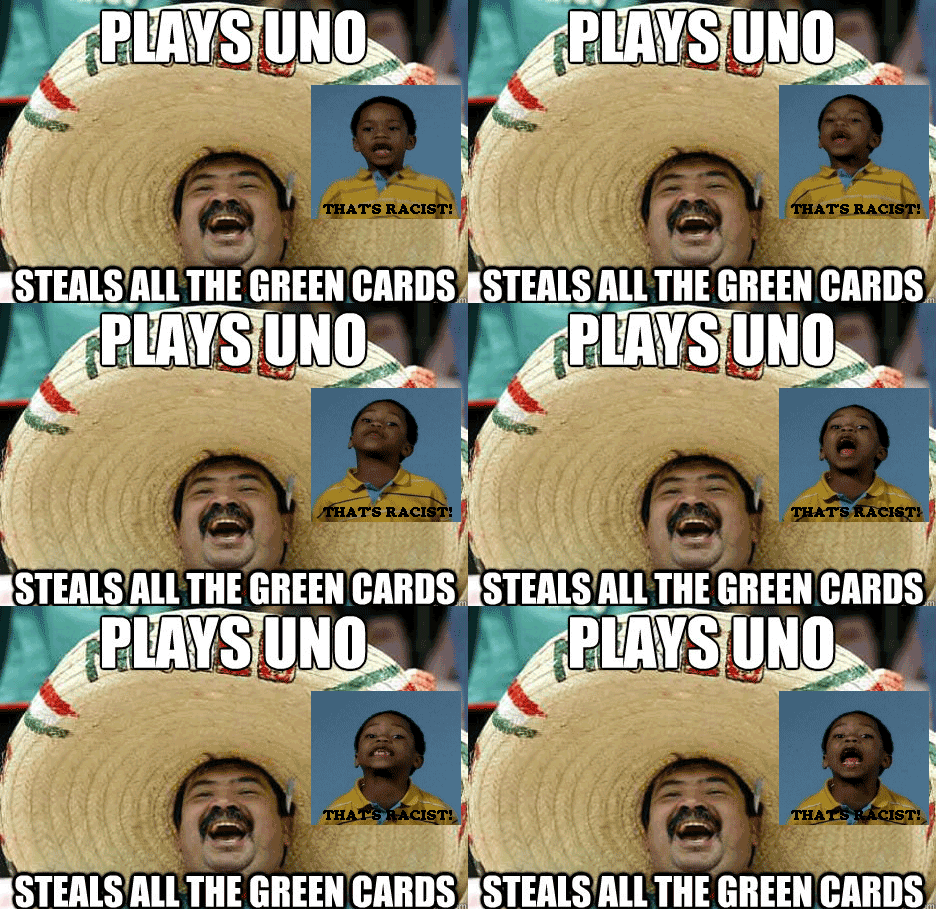
The following image was posted on a meme website. 

(http://memes.survivedavis.com/details.php?image_id=594)

This meme could be taken as being fairly offensive, it's definitely racist, however no one posted any angry comments about it. I'm sure people of all ethnicities saw it, yet no one seems to have gotten offended. No one knows who posted it, or whether they're black, white, asian, or a unicorn; the author doesn't matter, people just saw the joke, and took it for what it is. 

Racism has been a very touchy topic for the duration of my lifetime, although it seems now that racism itself is becoming the joke. 

http://knowyourmeme.com/memes/thats-racist


This particular meme is clearly making fun of Mexicans immigrating to the United States, but it's also basically saying "racism...hahahhahaah". Because of online anonymity, most people are just willing to laugh off stereotypes, without getting offended. Anyone can make fun of anyone in this form, it's open season, and it has to be; if we can't laugh at all of it, then we can't laugh at any of it, and no one wants a humourless internet.